One flat note, played again and again. That is what very does to a page of writing. The film was very good. The hero was very brave. The ending was very sad. Nothing is wrong with any of those sentences — but each one stops at exactly the same volume, so the reader soon stops feeling any of them. Very is an intensifier: its whole job is to turn the volume up on the word that follows it. English keeps a whole row of these dials, from a gentle really to an all-the-way utterly — and, better still, strong adjectives that need no dial at all.
The closest synonyms of very are really, extremely and truly. Really is the everyday twin — the same strength, at home almost everywhere. Extremely turns the volume one notch higher and suits essays and reports. Truly adds sincerity, so it belongs with feelings and thanks. For formal writing, highly and particularly are the polished choices, and when even extremely feels weak, utterly — or one strong adjective instead of two words — finishes the job.
Quick list: really, truly, particularly, highly, greatly, extremely, incredibly, exceptionally, deeply, utterly, so, super, terribly
This article covers 13 true synonyms for very, grouped by strength and by register, each with its meaning, pronunciation and an example. It then answers the question most searchers are really asking — what to write instead of very good, very big or very tired — with 24 one-word upgrades. Along the way it settles when very is perfectly fine, and when teachers reach for the red pen.
Contents
- Very Synonyms in One Table
- Safe Swaps That Work Almost Anywhere
- Stronger Than Very: Turning the Dial Up
- From Speech: Informal Intensifiers
- Drop Very Altogether: 24 One-Word Upgrades
- When Very Is Fine — and When Editors Cut It
- Turning the Volume Down: Antonyms of Very
- Mistakes Learners Make with Very
- Questions People Ask about Very
- Say It Once, Say It Strong
Very Synonyms in One Table
| Synonym | Strength vs. very | Register | Best partners |
|---|---|---|---|
| Really | The same | Neutral | Almost any adjective |
| Truly | The same, warmer | Neutral-formal | Feelings, thanks, big claims |
| Particularly | The same | Formal | important, useful, helpful |
| Highly | The same | Formal | likely, successful, recommended |
| Greatly | The same (for “very much”) | Formal | appreciate, improved, missed |
| Extremely | Stronger | Neutral | important, difficult, cold |
| Incredibly | Stronger | Neutral | kind, fast, lucky |
| Exceptionally | Stronger | Formal | talented, dry, cold |
| Deeply | Stronger | Neutral-formal | sorry, concerned, moved |
| Utterly | Strongest | Neutral | exhausted, ridiculous, silent |
| So | The same, emotional | Informal, spoken | cute, tired, hot |
| Super | Stronger | Informal, spoken | easy, excited, helpful |
| Terribly | The same or stronger | Informal, British | nice, sorry, important |

Safe Swaps That Work Almost Anywhere
These five do the same job as very, at the same strength. What changes is the clothing: one is the spoken twin, two belong to careful writing, and two keep a small set of favourite partners.
1. Really
IPA: /ˈrɪəli/
Definition: Very; also “in fact, truly”. The general-purpose intensifier of spoken and written English.
Usage: The closest twin of very and the easiest swap: really good, really fast, really sorry. It can also stand before verbs, where very cannot go — I really think so.
Example: The hotel was really close to the beach, so we walked there every morning.
2. Truly
IPA: /ˈtruːli/
Definition: Really and sincerely; very, said with feeling.
Usage: Slightly formal and warm. It suits feelings, thanks and large claims: truly grateful, truly sorry, a truly great leader. It sounds over-dressed on plain physical facts — a “truly long queue” is too much coat for a queue.
Example: She was truly delighted when her students passed with top marks.
3. Particularly
IPA: /pərˈtɪkjələrli/
Definition: Especially; more than usual, or more than the others.
Usage: The formal writer’s choice when one thing stands out from the rest: particularly important, particularly useful for beginners. Because it singles out, it fits advice and comparisons better than plain description.
Example: This chapter is particularly helpful if you are revising the night before an exam.
4. Highly
IPA: /ˈhaɪli/
Definition: Very; to a high degree.
Usage: Formal, and loyal to a small set of partners: highly likely, highly successful, highly skilled, highly recommended. It cannot wander — “highly happy” and “highly big” are wrong. Before verbs it does the very-much job: I highly recommend it.
Example: The vaccine is highly effective, and doctors recommend it for older patients.
5. Greatly
IPA: /ˈɡreɪtli/
Definition: Very much; to a great degree.
Usage: The formal stand-in for “very much” rather than for very alone. It stands before verbs and participles: greatly appreciate, greatly improved, greatly missed. Never before a plain adjective — not “greatly good”.
Example: Your advice greatly helped me during my first month at university.
Stronger Than Very: Turning the Dial Up
Sometimes very is not wrong, just too weak for what you mean. These five push past it — each in its own direction, so the right one depends on what is being described.
6. Extremely
IPA: /ɪkˈstriːmli/
Definition: Very much indeed; near the top of the ordinary scale.
Usage: The standard stronger-than-very word for essays, reports and news: extremely important, extremely difficult, extremely cold. Safe, clear and never too emotional.
Example: The desert road was extremely dangerous after dark, with no lights for miles.
7. Incredibly
IPA: /ɪnˈkredəbli/
Definition: Extremely; so much that it is almost hard to believe.
Usage: Strong and often admiring: incredibly kind, incredibly fast, incredibly lucky. It keeps a hint of surprise, so it suits stories and praise better than cold facts.
Example: The old laptop is incredibly slow, but it has never once crashed.
8. Exceptionally
IPA: /ɪkˈsepʃənəli/
Definition: Extremely; unusually, beyond the ordinary run of things.
Usage: Formal and measured: exceptionally talented, exceptionally dry weather. It quietly says “an exception to the rule”, which is why reports, references and examiners like it.
Example: It was an exceptionally cold April, with snow falling twice in one week.
9. Deeply
IPA: /ˈdiːpli/
Definition: Very strongly, in feeling or in a way that reaches far down.
Usage: The feelings specialist: deeply sorry, deeply concerned, deeply moved, deeply religious. It belongs with emotions and beliefs, not with sizes, prices or speeds.
Example: He was deeply ashamed of how he had spoken to his father.
10. Utterly
IPA: /ˈʌtərli/
Definition: Completely; absolutely, to the last drop.
Usage: The strongest word in this article, and it chooses extreme or unhappy partners: utterly exhausted, utterly ridiculous, utterly silent. With mild words it sounds strange — nobody is “utterly nice”.
Example: By midnight the hikers were utterly exhausted and ready to sleep anywhere.
From Speech: Informal Intensifiers
In conversation, native speakers often trade very for words with more colour. The three below are everywhere in speech and messages — and each one has a fence around it in formal writing.
11. So
IPA: /soʊ/
Definition: Very; to such a great degree.
Usage: Spoken and emotional: “The baby is so cute!” It often pulls a result behind it — so tired that I fell asleep at the table. Left alone in careful writing, it can feel like half a sentence.
Example: The soup was so hot that we had to wait ten minutes before eating.
12. Super
IPA: /ˈsuːpər/
Definition: Very; extremely (informal).
Usage: Young, friendly and mostly American: super easy, super excited, super helpful. Perfect for chats and messages with friends; keep it out of essays and job applications.
Example: The instructions were super clear, and I built the shelf in twenty minutes.
13. Terribly
IPA: /ˈterəbli/
Definition: Very; extremely (mainly British, slightly old-fashioned).
Usage: Its partners surprise learners, because they are usually pleasant: terribly nice, terribly sorry, terribly important. In British speech it is polite emphasis, not bad news. American speakers use it far less.
Example: She was terribly pleased with the flowers her class had sent.
Drop Very Altogether: 24 One-Word Upgrades
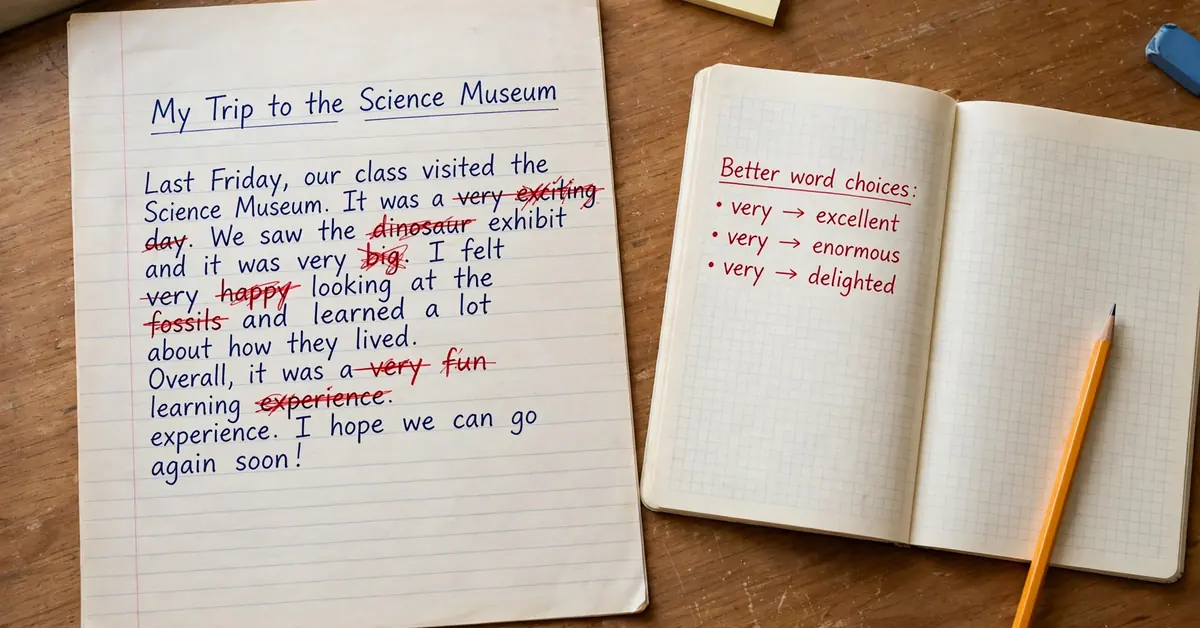
Here is what the red pen is really doing. The strongest fix is often not a better word before the adjective, but a better adjective: excellent already contains “very good” inside it, and exhausted is “very tired” with the work done. Praise words wear out fastest of all — our guide to another word for great works through that whole family — but the pairs learners reach for most are these:
| Instead of… | Write… |
|---|---|
| very good | excellent |
| very bad | awful |
| very big | enormous |
| very small | tiny |
| very fast | swift |
| very happy | delighted |
| very sad | miserable |
| very tired | exhausted |
| very hungry | starving |
| very cold | freezing |
| very hot | boiling |
| very scared | terrified |
| very angry | furious |
| very sure | certain |
| very important | crucial |
| very beautiful | gorgeous |
| very clean | spotless |
| very dirty | filthy |
| very interesting | fascinating |
| very funny | hilarious |
| very bright | dazzling |
| very quiet | silent |
| very loud | deafening |
| very old | ancient |
Notice the pattern: the words on the right describe the top of a scale, so they already stand at full volume. That is also why very clashes with them — “very exhausted” doubles the force, like turning up a speaker that is already at maximum.
When Very Is Fine — and When Editors Cut It
Very is fine more often than strict teachers admit:
- In speech. Nobody edits conversation. Very good and very nice are natural, friendly and clear.
- Before adjectives with no stronger partner. Very careful, very polite, very modern — careful has no “excellent-style” single word waiting, so very earns its place.
- In fixed phrases. Thanks very much, the very best, not very happy, her very own room. These are set shapes of the language; do not touch them.
Editors reach for the pen in two situations. First, repetition: three verys in one paragraph flatten each other, because emphasis spent everywhere is felt nowhere. Second, before top-of-scale adjectives: very exhausted, very perfect, very unique weaken the word they stand before (the mistakes section below explains why). The rule is not “never use very” — it is “spend it where it still buys something”.
Turning the Volume Down: Antonyms of Very
Very turns the volume up. Its opposites turn it down, and every learner needs both directions.
For a moderate degree: fairly (fairly good means good, but with limits), rather (a slightly formal, mostly British downtoner: rather disappointing), somewhat (the formal choice: somewhat surprised) and a bit (spoken: a bit tired, a bit late).
For a small degree: slightly — slightly annoyed, slightly warmer. It is the polite minimum, often used to soften a complaint.
One warning belongs to quite. In British English, quite before an ordinary adjective means fairly — quite good is praise with the edges left on. Before an absolute adjective it flips to “completely”: quite right, quite sure, quite dead. Read the adjective before you decide what quite has said.
Mistakes Learners Make with Very
Saying “very unique” or “very perfect”. Unique, perfect, dead and empty are absolute words: something either is unique or it is not, so it cannot be “more unique” by degree. Careful writers say unique on its own, or nearly unique, almost perfect. Casual speech bends this rule; school and exam writing gets marked for it.
Putting very before a verb. “I very like it” is wrong — very works on adjectives and adverbs, not on verbs. For verbs, use very much at the end of the sentence (I like it very much) or really before the verb (I really like it).
Confusing very and too. Very is a high degree, and neutral: very hot weather can be a holiday treat. Too means more than wanted, and it always complains: too hot means you cannot stand it. One letter’s difference, opposite feelings.
Doubling it: “very, very happy”. Excited speech does this, and small children do it charmingly. On the page it just looks unedited. Upgrade the adjective instead — delighted was built for exactly this moment.
Leaving so unfinished. “The film was so good.” stops halfway in writing, because so begs the question “so good that what happened?” Either finish the result (so good that we watched it twice) or use very or really.
Questions People Ask about Very
What is another word for very?
Really for everyday use, extremely when you need stronger, truly for feelings and thanks, and highly or particularly in formal writing.
What can I write instead of very good, very big and very tired?
Excellent, enormous and exhausted. Single strong adjectives like these do the work of both words — the table above lists 24 of the most useful pairs.
Is very a bad word in essays?
No. One very, chosen on purpose, is fine. The problem is habit: five verys in a page tell the examiner you stopped choosing words.
Can I say very unique?
Careful writers avoid it, because unique is absolute — a thing is one of a kind or it is not. Write unique alone, or nearly unique.
Really or very — what is the difference?
Before adjectives they mean almost the same. Really goes further: it works before verbs (I really think so) and can also mean “in fact”. Very can do neither job.
What is a formal word for very?
Highly with its fixed partners (highly likely, highly recommended), particularly, exceptionally, and greatly for the “very much” job.
Say It Once, Say It Strong
Very is not a mistake; it is a habit. It asks the reader to trust that the next word matters instead of showing them why. Keep it for conversation, for thanks very much, and for the adjectives that have no stronger partner. Everywhere else, climb one rung — really, extremely, utterly — or hand the whole job to one strong adjective. A page where very appears once, chosen on purpose, says far more than a page where it appears ten times by reflex.

Rana Fareed writes about words — their meanings, synonyms, and the small differences between them — so learners can choose the right word with confidence.